Page 3 of 8

Chemical exposure during childhood linked to cancer

about-the-smart-human-image-300x269New research is solidifying the link between childhood chemical exposure and the increased risk of cancer, often from daily household products. Limiting exposure by using products known to be less harmful and can help reduce this risk. Standards such as the Living Building Challenge Red Petal list, and the WELL Building Standard, are addressing these risks to health. See the full article here.


Views of green roofs can have cognitive benefits in less than 40 seconds

gr.leestudy.restor.2015

A new study published in the Journal of Environmental Psychology has found that even simulated views of green roofs improved cognitive tasks completion in participants in 0-40 seconds. Participants were given a difficult cognitive task, and then half were shown the image on the left of a concrete roof, and have the image on the right, of a green roof in flower. Those who saw the concrete roof performed worse on the cognitive task the after viewing the concrete roof, while those who saw the green roof image performed better. Researcher Kate Lee reports: “this indicates higher sub-cortical arousal and better attention control after viewing the green, rather than the concrete roof.” Click here to see the original article, and here for the journal.

Study shows that appealing to health benefits better incentive to save energy

A new study has shown that messaging about the reduction in childhood asthma and cancer from decreased power usage was the most powerful factor in changing household behaviour for energy conservation. Households who were told this message reduced their power usage by 8%. Households with children at home were the most impacted by this message: they reduced their energy consumption by 19%. To read about the study click here.

airpollution

Harvard Researchers pushing for more research on links between health and green space in cities

Researchers at Harvard’s centre for Nature, Health, and the Built Environment are calling for more research to better understand how cities can take advantage of green space, ecological needs, and human health in the face of climate change. Areas of interest include what aspects of nature may have medicinal qualities, how cities can be designed for more resilience and human health, and how nature affects the brain. For the full article click herecloseup-flwer3.jpg

Green Building Materials Market predicted to reach $235 billion by 2019

New research by the Transparency Market Research group predicts that green building materials will be a huge market by 2015. This is not surprising given the increased credits given to avoiding toxic materials in LEED v4.   The USGBC’s materials research, combined with the American Standards and Testing Materials association (ASTM) are also working on identifying materials hazardous to human health. You can read about this movement towards healthier materials here, here, here.

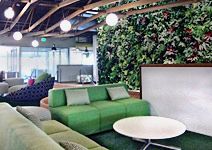
Green wall at Google helps to filter the air and provide respite for employees.

Research on the health hazards of sitting at work

Workplaceinsight.net graphic on the health hazards of sitting.

There has been a lot of research recently on the health hazards of sitting all day at work. For example, a 2011 Center for Disease Control study found that when workers were provided with sit-stand desks, the rate of sitting was reduced and mood was improved.

Studies in 2010 and 2009 have found that adults who sat for their leisure time had an increased risk of disease and a shorter average lifespan (2010 study),  while the 2009 study found that metabolic health is compromised even for adults who met the physical activity guidelines.

The research is so convincing that in 2013 the American Medical Association adopted a policy that recognizes the hazards of sitting and encourages alternatives to sitting for workers, such as sit-stand desks.

For more research and the original reports, click here.

New study shows Happier Workers are more productive

A new study out of the University of Warwick showed that workers are 12% more productive when happy. Economists carried out four studies with more than 700 participants, and is the first to show casual evidence using randomized trials and piece-rate work. Researchers used real-world negative events, such as illness or death in participants’ families, to imitate long-term states versus shifting affect.

workplace-meetings-productivity (1)

The results in all four studies showed a positive correlation between increased productivity (measured in tasks that required concentration, such as mathematical tasks). It would be interesting to see how productivity is measured in more complex, creative tasks, which to date have not been well-addressed by research.

To see a synopsis of the article, click here. To download the full article, click here.

Cycling creating more jobs in Europe than automakers in the US

A recent EU study, the most comprehensive to date, has found that cycling and related industries are employing more than 655,0oo people in industries such as tourism, manufacturing, infrastructure investment and retail.

Of particular note are the number of jobs being created in Europe’s high-fashion footwear industry (388,000) and steel industry (410,000), which is higher than the US’s big three automobile companies combined (510,000).

Click here for more information. download

10 Key Design Principles for a healthier, happier workplace

Gensler has long been at the forefront of research on occupant and workplace satisfaction, workflow, and workplace trends. Their work has recently come out with ten principles to increase worker health and happiness, and include things like providing control over their work environment, access to nature, good ventilation, and good acoustics. Read about their ten principles here.3OLSON.gensler.workplace